
Manufacturers generate enormous amounts of data every day. ERP, MES, Quality, Procurement, Supplier Management, and Inventory systems continuously capture transactions, performance metrics, and operational events. Yet supply chain disruptions are still frequently discovered only after production schedules slip, customer commitments are missed, or revenue is impacted. The challenge is not a lack of data. The challenge is transforming disconnected information into actionable intelligence before problems occur.
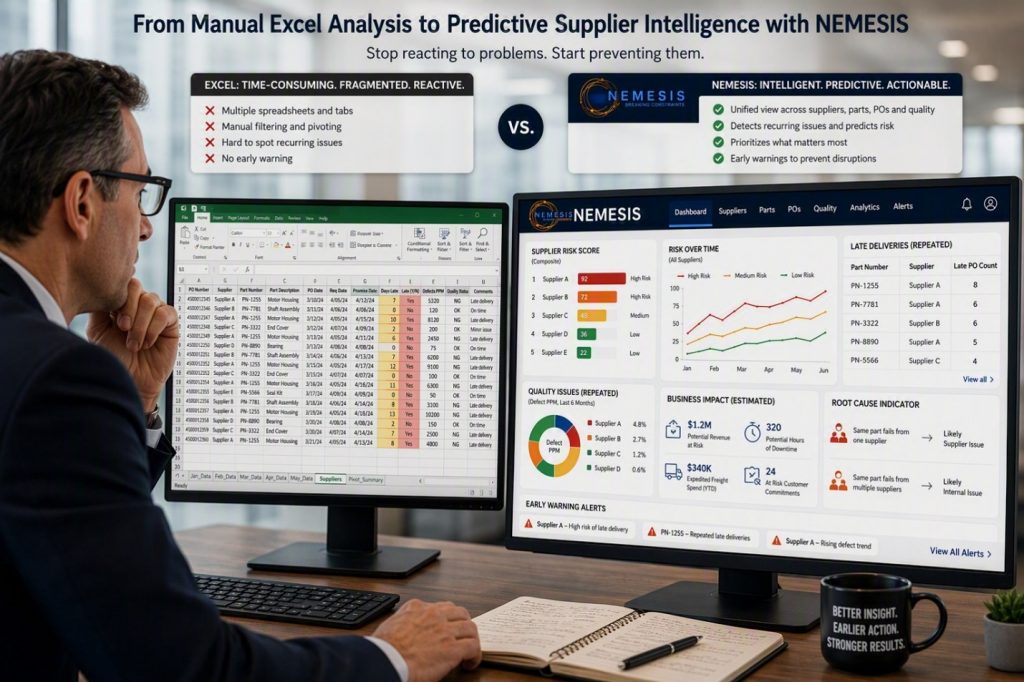
NEMESIS® helps manufacturers move beyond reactive management by converting fragmented operational data into predictive supply chain intelligence. By integrating with existing enterprise systems, the platform continuously analyzes supplier performance, quality incidents, delivery trends, compliance records, corrective actions, and operational outcomes to identify emerging risks before they disrupt production.
Consider a supplier that begins showing signs of deterioration. Deliveries become increasingly late, defect rates begin to rise, compliance documents are missing, and corrective actions remain unresolved. Individually, these issues may appear manageable. Viewed collectively, they reveal a pattern that signals elevated supply chain risk. NEMESIS® identifies these patterns early and alerts leaders before production schedules, customer commitments, or financial performance are affected.
However, supplier risk is only part of the story.
For manufacturing leaders, the critical question is not simply which supplier is at risk. The more important question is:
What business impact will that risk create?
A delayed or defective component rarely affects a single purchase order. Through complex Bills of Material (BOMs), a single supplier issue can ripple through assemblies, sub-assemblies, finished products, customer orders, and revenue streams. A component supplied by a high-risk vendor may ultimately affect multiple products that generate millions of dollars in annual sales.
NEMESIS® connects supplier risk with product build schedules structure and operational outcomes. By tracing dependencies through multi-level Bills of Materials, the platform helps organizations understand exactly which parts, assemblies, finished goods, and customer commitments are exposed to disruption. Instead of treating every supplier issue equally, leaders can prioritize actions based on operational and financial impact.
The platform enables manufacturers to:
- Identify suppliers with increasing delivery, quality, or compliance risk.
- Detect recurring patterns that indicate future supply chain disruptions.
- Trace supplier risk through multi-level Bills of Material.
- Identify critical parts that support high-value products and customer commitments.
- Quantify potential production, operational, and revenue impact.
- Distinguish supplier-related issues from internal design, engineering, or manufacturing process problems.
- Prioritize supplier engagement and corrective actions based on business risk.
- Provide daily early warnings that enable proactive decision-making.
Unlike traditional reporting tools that explain what happened yesterday, NEMESIS® focuses on what is likely to happen next. The platform continuously learns from historical and current operational data to identify risk patterns, emerging trends, and potential disruptions before they become costly problems.
NEMESIS® does not replace ERP, MES, Quality Management, Procurement, or Supplier Management systems. Instead, it enhances the value of those investments by connecting data across organizational silos and uncovering relationships that are difficult to detect through conventional reporting. It transforms operational data into predictive, actionable intelligence that supports faster and better decisions.
The result is more than improved supplier management. Organizations gain fewer production disruptions, lower operating costs, improved supplier performance, stronger customer service levels, and greater supply chain resilience. Most importantly, they gain visibility into how supplier risk translates into business risk.
The manufacturers that outperform their competitors are not simply the ones that react faster when problems occur. They are the ones that anticipate disruptions, understand their downstream impact on production and revenue, and take corrective action before customers and business are affected.
Predictive supply chain intelligence is no longer a competitive advantage. It is rapidly becoming a business necessity.